
Unfed Sourdough Pizza Crust
So, you've got a sourdough starter in the fridge. Now what?
So, you've got a sourdough starter in the fridge. Now what? My favorite way to use starter is to add unfed starter to baking recipes such as pancakes, pretzels, and pizza dough. What is unfed sourdough? It is the cup of starter that you remove BEFORE each time you feed your starter, hence the name "unfed." Using unfed starter gives your recipes a boost of yeast and a ton of flavor.

Here is the recipe I use to make an easy pizza crust in my bread machine:
1 cup unfed sourdough starter
1/2 cup lukewarm water
2 1/2 cups unbleached white flour
1 tsp. salt
1/2 tsp. yeast
Directions: Add all ingredients to your bread machine. The list above is in the order that my bread machine requires; adjust accordingly if your bread machine works better with a different order of ingredients. Run your bread machine on the Dough cycle. When the dough is finished in the bread machine, remove and shape into two pizza crusts (or one VERY thick crust). Cover crusts and allow to rest for 15 minutes. Prick the top of each crust in multiple places with a fork. Bake at 450 degrees F for 8 minutes, remove crusts from oven and add pizza toppings, then return pizza to the oven to finish baking for 10 minutes more. Keep an eye on the pizza until you get a feel for the temperature of your oven, as they can burn quickly at 450 degrees, and adjust cooking time accordingly.

Remove 1 cup of unfed sourdough starter as the basis of this recipe..
How to keep your sourdough starter happy
Over the years, I had all but given up on keeping a sourdough starter, but six months ago I was gifted with a starter from King Arthur Flour, which has tended the same starter for 300 years (and it's local to me). Determined to succeed, I scoured the internet for updated information on how to keep and how to use a sourdough starter. It's really quite simple, if you want it to be.

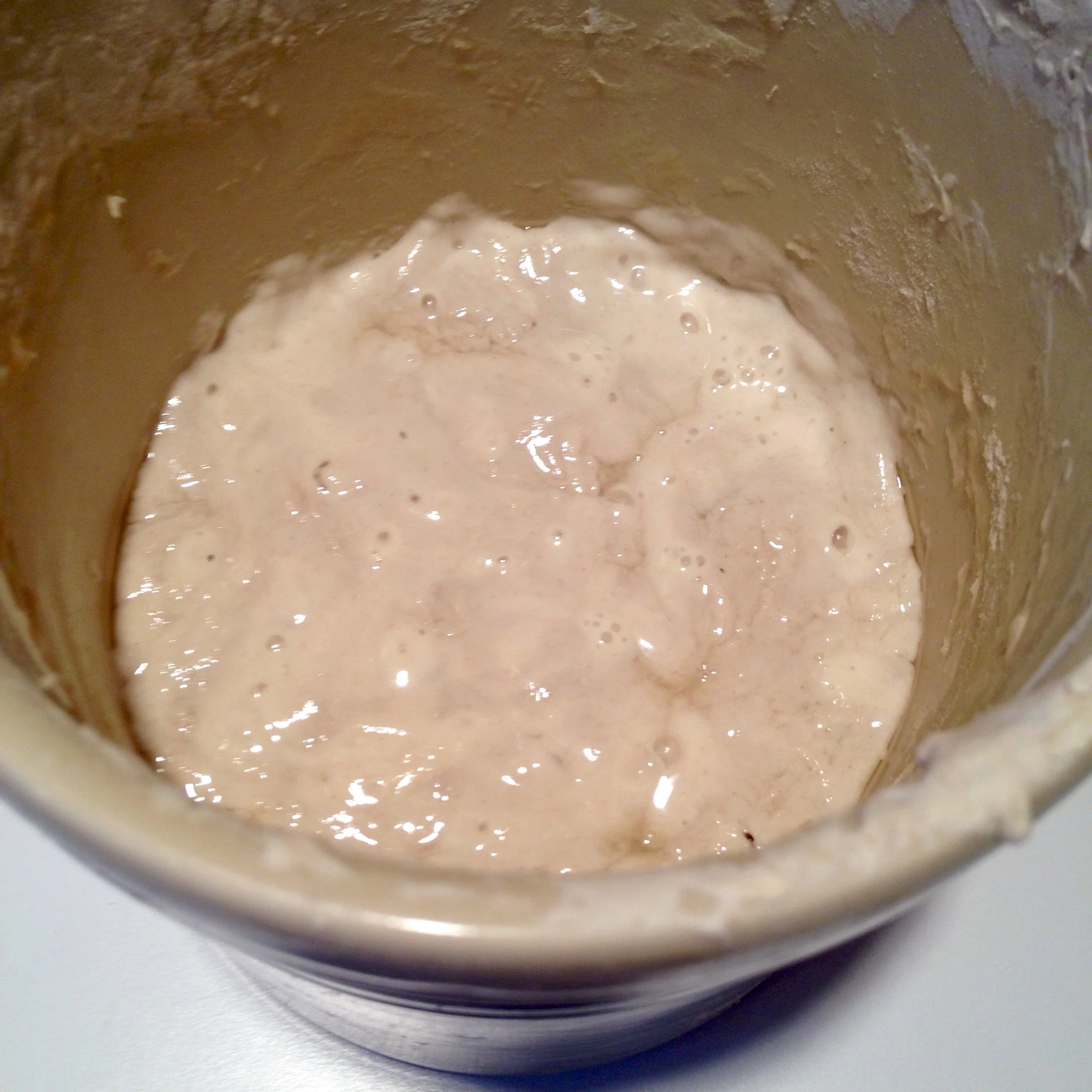
Unfed sourdough, after one week in the fridge.
So, you want to keep a sourdough starter? Maybe a well-meaning friend passed along an "extra" half cup of the stuff, or maybe you've tried to keep a starter in the past, but found it to be too complicated and fussy to keep alive for long. I was one of those people for years: receiving starter as a gift occasionally, not quite sure what to do with it, and there was that unfortunate time in 2009 when I attempted to create a whole wheat starter from scratch in my New York kitchen.
Over the years, I had all but given up on keeping a sourdough starter, but six months ago I was gifted with a starter from King Arthur Flour, which has tended the same starter for 300 years (and it's local to me). Determined to succeed, I scoured the internet for updated information on how to keep and how to use a sourdough starter. It's really quite simple, if you want it to be. To maintain a sourdough starter:
1) Place 1/2 cup of sourdough starter in a glass or ceramic crock that has a cover. As with all ferments, your starter will do better in a wider container, and the cover must allow the starter to breathe, e.g. don't use a tightened down ball jar lid. I use this lovely crock:

Whatever container you decide to use, make sure it holds at least one quart. Sourdough starter bubbles and expands when it's happy, and you'll need some extra space in the container.
If your starter is already going and you just need to feed it, remove 1 cup of unfed starter, leaving approximately 1/2 cup of starter in the container ready to be fed. Use the unfed starter in recipes for pancakes, waffles, crumpets, pretzels, bread, or pizza dough.
2) Add 1/2 cup lukewarm water and 1 cup white flour to your starter and stir in.

Be sure to measure your flour loosely; do not pack it down. Also, do not substitute other flours at this stage. There are ways to convert your starter to whole wheat flour, etc., but it's best to maintain your starter with white flour until you get the hang of it.

Fed sourdough resting at room temperature.
3) Cover starter and let sit at room temperature for 2 hours, then store in the fridge. Starters left longer than 6 hours will need to be fed again before being put in the fridge.
4) Feed your starter once per week, or whenever you remove 1 cup of starter for baking. In truth, a happy starter can be left for a month or more in the fridge without feeding, but feeding at least once per week will keep it healthier.
If you open your starter to feed it, and it is covered in a greyish liquid, don't fret! That liquid is mostly alcohol and just indicates that you went too long without feeding the starter. Pour off the liquid, and then feed your starter as usual. You can also stir the liquid back into the starter, if you prefer, but I always discard it.
If you find yourself needing to feed your starter, but with no time to bake, you can refrigerate the unfed starter in a separate container for quite a long time before using it in a recipe.
A note about your pets: sourdough starter, as with all bread dough, is poisonous to dogs. If you find yourself with extra starter, resist the urge to give your dog a taste. Sourdough is healthy and delicious for humans, but can be deadly for dogs.
Please ferment responsibly!
How to care for your sourdough starter:
1) Remove all but 1/2 cup of starter from the crock.
2) Feed remaining starter with 1 cup white flour and 1/2 cup lukewarm water. Stir.
3) Cover and let starter rest at room temperature for 2 hours. Return to fridge.
4) Repeat weekly.
(photos taken already)
A jade plant in bloom
A wonderful thing happened shortly before Christmas: one of my jade plants came into bloom! I didn't even know jade could bloom, and in an entire lifetime of keeping jaded as house plants, this is the first I've seen bloom.
A wonderful thing happened shortly before Christmas: one of my jade plants came into bloom! I didn't even know jade could bloom, and in an entire lifetime of keeping jaded as house plants, this is the first I've seen bloom.
The clusters of pink buds formed over a period of weeks, an then they opened slowly and bloomed for a very long time. It is over a month since the blooming started, and the flowers are still open, though just starting to fade.
i've done some reading since this unexpected blooming, and it seems that cold temperatures and direct sunlight are needed for a jade to bloom. I also suspect that a couple of early fall fertilizing gave the old potted plant a boost. This particular plant was a recent gift, and I'm pretty sure it hadn't ever been fertilized. My new (and now favorite!) fertilizer for house plants is a nettle infusion added to the watering can. To make the fertilizer, I use half a cup of dried nettle plant, steeped in one pint of boiling water for 12 hours. Strain and add to your watering can. This has been a wonderful alternative fertilizer since I gave up Miracle Grow in my journey towards a healthier, more sustainable life. I use nettle fertilizer on all of my house plants now, and the are blooming and thriving in a way I have never seen. Try it on you plants and let me know how it works for you!

jade plant in bloom
















Natural Protection for the Outdoors
Herbal Bug Spray is a refreshing, herb-infused mist designed to keep your comfortable during your time outdoors. Made with thyme and other herbs grown on our farm, this formula is thoughtfully crafted to help you enjoy nature without unwatned distractions. Light and easy to apply, it is perfect for hikes, picnics, or any adventure under the open sky.
Best For: Outdoor Adventures, Hiking, Gardening, Camping
Not for use on pets.
This 56 mL bottle comes with a treatment pump that can be refilled twice with our Herbal Bug Spray Refill.
We offer sliding scale prices. Please select an option below to support our small business at a price that matches your ability to pay.